The monolithic material prepared without methacrylic acid in the polymerization mixture showed a very low surface area of 0.1 m2/g, whereas the surface area of organic polymer monolith with methacrylic acid increased significantly up to 261 m2/g. The addition of methacrylic acid in to the polymerization mixture improves also separation power of prepared monolithic columns. Figure 1 shows the separation of the mixture of small molecules on the column without (A) and with (B) methacrylic acid in the polymerization mixture.
Couple of days ago, I mentioned on Chromatographer’s facebook page article by Peter Carr about speed in HPLC published in Analytical Chemistry. There are two parts in the article: (i) critical comparison of different approaches how to reach speed in HPLC and (ii) theoretical background of speed and efficiency optimization in high performance liquid chromatography.
Today, I would like to describe my favorite chromatographic books: from one I bought even before I (really) knew what chromatography is to one which has chapter with my name on it.
Recently, I was browsing amazon.com products related to the chromatography keyword. To my big surprise, the number ten (at least in my results) was a “16 oz. Double Wall Insulated Tumbler with chromatography column alone – Paper Insert”.
This is what I call a present for a chromatographer!
I waited until our next order (Harry Potter Playstation 3 game for my wife) and included the coffee tumbler in the order. Partly because I didn’t (want) understand, partly because of wishful thinking but I thought that the (chromatographic) paper is inserted in between the tumbler’s walls. It wasn’t. My bad. Instead, there was inserted paper with the picture of chromatographic column (ehmm, old fashioned burette). As advertised.
Anyway, I have decided to modify the tumbler to way I see it – original tea/coffee cup with the chromatographic separation on it. My only next condition was to avoid using any laboratory equipment.
So – if you are interested – you can very easily repeat the experiment in your kitchen and prepare your own original coffee cup.
To summarize, the aim of this small experiment is to perform thin layer chromatography of black office marker on a paper as stationary phase and use this paper as an original sign of a tea/coffee tumbler. No one else will touch it and everyone will ask about the way how to do it.
Ok, that’s plan.
A little bit of theory
The black markers usually contain more then a black color with several basic colors. Therefore, the black line traced on the filtration paper immersed with one side in the mobile phase is drifted towards the other side via capillary forces. During this journey the marker’s pigments are separated into the individual colors. Pretty much as a principle of thin layer chromatography ;-) Let’s start.
Materials
For our experiment we need: black marker as a sample, filtration paper as a stationary phase and some mobile phase. Further you might need a glass, cup or pot, pencil, scotch-tape, and scissors. That’s pretty it.
Preparation of a stationary phase
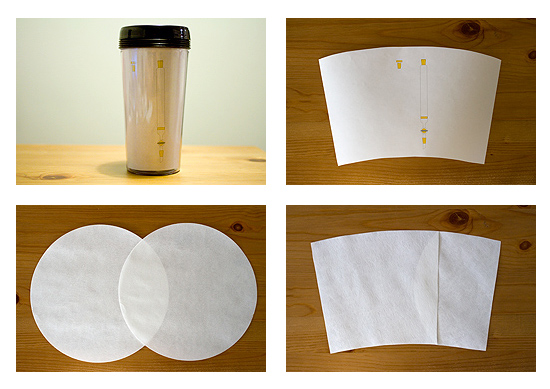
As a stationary phase I have used filtration paper from our lab. This is only one violation against my no lab staff condition. The filtration paper from the coffee machine can be successfully use too. We just don’t have any. The filtration paper I have had was smaller than the paper inserted in the tumbler, thus I used two of them and cut a right size and shape according the original paper.
Original tumbler and preparation of filtration paper as a stationary phase
The reaction vessel
An empty glass. Or a cup, pot; whatever fits your paper and purpose. Better if you can have one with a lid. With the lid, vapor of your mobile phase fills vessel and speed up and improve the separation. In my case, I have used an ordinary kitchen glass (made by ikea).
Sample
As a sample I have used black Expo Vis-à-vis wet erase marker. I have tested two different markers: Expo and Sharpie. The reason why I used the Expo is that with Sharpie I didn’t get a nice separation.
Hint #1: you better try the separation before the one you want to use in your tumbler. In this case, you can select the marker you like the most.
From analytical point of view, this can be used to indentify unknown marker: just compare their traces.
Mobile phase
That’s my favorite part. As a mobile phase I have used vodka. I told you: no lab staff ;-) You can probably use any distilled brandy. I would prefer the transparent one since I am not sure about the color of (evaporated) whisky on the stationary phase paper. Since the vodka (or any kind of home made brandy) is in the range of 40 – 50% the further dilution is not necessary. In lab I would use acetonitrile : water mixture (70 : 30 or 80 : 20 ratio). The concentration composition of this mobile phase can vary depending on the desired speed and resolution of separation.
Home-made thin layer chromatography
Ok, all stuff is ready. Let’s go. First, I labeled the paper with the marker. The length of your line is up to you. You would prefer either the long line through the width of the paper or short line covering only small part of the paper. I made a 5 cm (2”) long line roughly 2.5 cm (1”) from the edge of paper. This side (under the line) is then going to be immersed in the mobile phase.
Hit #2: To help paper fits the glass I curled the paper and used hairpins to hold it. Use new ones. Otherwise you can very easily get dirty paper.
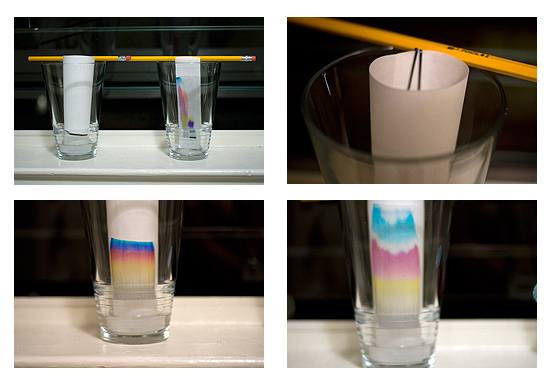
Finally, to hold the paper in a vertical position I have used a pencil. You should have avoided any touch of the paper and glass wall. The mobile phase then flows equally without any restrictions, dispersions or speed ups.
Development of the separation (togerther with a test trace comparing two different markers – top left)
After immersing the paper in your favorite mobile phase, the liquid starts to rise via capillary forces and takes a sample with it. The low retained colors are faster than the more retained ones and “run” towards the opposite end of the paper faster. In our case you can see almost immediately after a start quick separation of four colors: black, yellow, red, and blue. As separation continues, the colors are separated more and more and later on you can notice total separation of least retained blue color from other colors. When the mobile phase reaches the other end of the paper, the separation is done. To cover only specific space of the paper, you might wish to stop the run sooner. All you need to do is then remove paper from the glass.
Happy chromatographer with a final product ;-)
When the separation is finished, move the paper to other glass and let it dry. Your original sign of chromatographic society membership is ready for use.
Have fun and enjoy your coffee, tea or any kind of tasteful mobile phase.
One of the most important characteristics describing the column properties is column permeability. Term permeability refers to the column packed with a stationary phase (particles or monolith) and describes how easy flows the liquid (mobile phase) through the column.

 products related to the chromatography keyword. To my big surprise, the number ten (at least in my results) was a “16 oz. Double Wall Insulated Tumbler with chromatography column alone – Paper Insert
 ”.
”.